
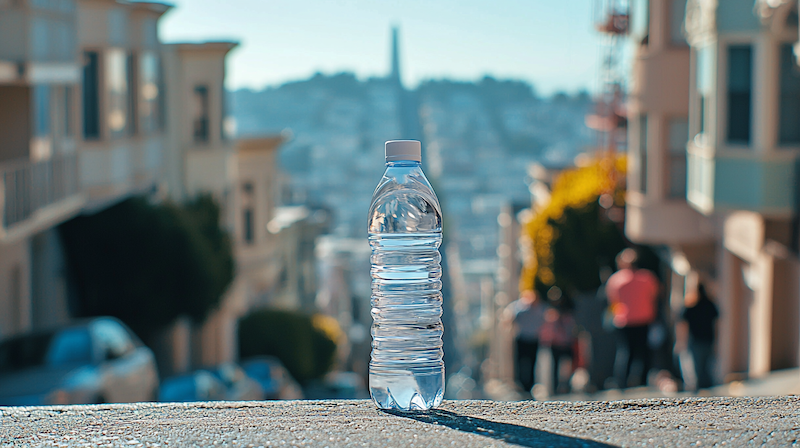
Why we track water (and why you probably drink less than you think)
You open the app after lunch. You log the chicken, the rice, the salad. And there it is: a half-empty bottle reminding you that all you've had today is a coffee and a juice.
It's not a judgment. It's data. And that data matters more than you think.
Water isn't optional for everything else to work
If you're using One Step Health to improve your nutrition, train better, or lose fat, water isn't an extra. It's the infrastructure that everything else runs on.
Without enough hydration, the protein you eat is metabolized less efficiently. Training performance drops sooner. Hunger gets confused with thirst. And that mid-afternoon energy crash you blame on "not eating enough" is often just mild dehydration.
That's why water lives in the Food tab and isn't hidden in some general health section. It's part of what you eat. Or it should be.
Why 2 liters and not some other number
The 2 liters are a reasonable reference for an adult with moderate activity, not a universal law. The EFSA (European Food Safety Authority) sets an adequate intake of 2 liters for women and 2.5 for men counting all sources, including food.
In One Step Health we use 2 liters as the base goal because it works as an anchor for most users. If you train hard, if it's hot, if you're male or have more muscle mass, you need more. The goal is adjustable in your profile.
What doesn't change is the principle: most people drink less water than they think, and visual tracking, however simple, helps correct that.
What happens if you don't hit 2 liters
Nothing dramatic. You won't dehydrate from drinking 1.6 liters one day. Your body has regulatory mechanisms that handle occasional shortfalls just fine.
What does happen when the deficit is habitual: thirst is the last indicator, not the first. By the time you feel thirsty, you've been suboptimally hydrated for hours. Tracking exists precisely to act before reaching that point.
The bottle in One Step Health doesn't turn red or make you feel guilty if you miss the target. It gives you information. What you do with it is up to you.
Water from coffee, milk, and fruit counts too (but not entirely)
This is where most confusion happens.
Coffee and tea contribute to net hydration even though they're diuretic. Caffeine has a mild diuretic effect, but the volume of liquid you consume more than compensates. A coffee made with 200 ml of water provides real hydration. Not as much as plain water, but it counts.
Milk and plant-based drinks are 87-90% water. They contribute significantly to total hydration. A 250 ml glass of milk equals roughly 220 ml of effective water.
Fruits and vegetables provide between 80 and 95% water depending on the food. An orange, cucumber, watermelon, or tomato are relevant hydration sources that never show up in the water counter but do add to your real total.
So why do we only track the water you drink?
Because trying to add up the water from every food you eat adds complexity that doesn't pay off. The 2-liter target in One Step Health is calibrated assuming you already get an extra 0.5 to 1 liter from food. We're not ignoring those sources — the target already accounts for them.
Alcohol is a different story
Alcohol is actively diuretic, not mildly. It inhibits antidiuretic hormone (ADH), causing your kidneys to filter and eliminate more water than usual. For every gram of alcohol consumed, the body can excrete up to 10 ml of additional urine.
The practical result: a night of drinking can leave you with a real hydration deficit the next day even if you drank liquids. Hangovers have many factors, but dehydration is one of the main ones.
In One Step Health we don't count alcohol as a hydration contribution. If you drink, the advice is to compensate with extra water that same night or first thing the next morning.
Why a bottle and not glasses
The "8 glasses a day" metric is the most well-known and also the most arbitrary. A glass can be 150 ml or 300 ml. The number gives no real information about actual progress.
The bottle that fills with each 250 ml isn't a visual gimmick. It's a proportional representation: you see at a glance how much you have left without needing to do any math. And at 2 liters, it's full. Done.
One tap to add. Long press to correct if you went over. No friction, no forms, no unnecessary precision.
Because what works isn't the most accurate system. It's the one you keep using.
What counts and what doesn't
| Counts toward the goal | What we don't count |
|---|---|
| Plain water | Water from fruits and vegetables |
| Herbal teas and tea | Water from milk and plant drinks |
| Coffee (with caveats) | Alcohol (negative effect) |
| Broths and soups | Water from cooked foods |
The 2-liter target in One Step Health assumes you already get 0.5-1 extra liter from food. If your diet is very low in fruits and vegetables, consider raising the goal to 2.5 liters.