
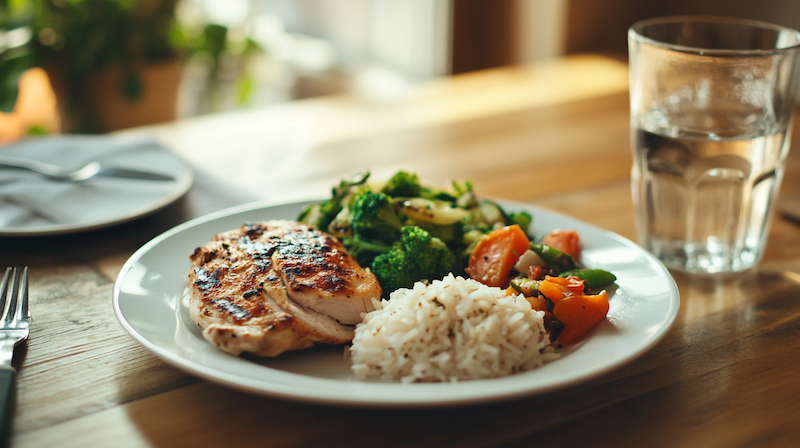
How to log what you eat without obsessing over quantities
You already know that counting every calorie doesn't work. But now the logical question arises: if I'm not weighing everything to the gram, how do I know what I'm eating? Is 500g of chicken a lot? Does it matter if I eat a kilo of vegetables? Does smoked salmon count the same as fried?
Let's clear this up.
Think in portions, not grams
Before we get into how to log, let's talk about how to think about quantities. Your hand is the best visual reference you have — it's always with you, it's proportional to your body, and it helps you estimate without weighing anything:
- Protein (chicken, fish, meat, tofu): one palm ≈ 120-150g
- Carbs (rice, pasta, potato): one closed fist ≈ one portion
- Fats (oil, nuts, avocado): one thumb ≈ one tablespoon
- Vegetables: as much as you want (we'll get to that)
This is just so you have a mental picture. In One Step Health, you don't need to think about this — each food already has its own serving size built in (1 serving, 1 cup, 1 piece, 1 handful...). You just pick the food and how many servings you had. That's it.
Is 500g of chicken a lot or a little?
It depends on who you are, but here's the quick reference:
| Goal | Protein per meal |
|---|---|
| Sedentary person | 1 serving (120-150g) |
| Active person | 1.5-2 servings (180-300g) |
| Intense training | 2-2.5 servings (250-400g) |
So 500g of chicken in a single meal is a lot for almost anyone. But 500g spread across two meals is perfectly reasonable if you train.
What matters to log: how many servings of protein you had today, not the exact grams. If you put "Chicken, 2" at lunch and "Eggs, 3" at dinner, you already have a clear picture.
Vegetables: the food you don't need to measure
Here's a simple rule: vegetables are free. You don't need to measure whether you had 200g or 500g of broccoli. The caloric density of vegetables is so low that the quantity doesn't move the needle.
Can you eat a kilo of vegetables? If you can, go for it. You're getting fiber, micronutrients, and satiety for practically zero caloric cost.
The only thing worth logging is whether you ate vegetables or not:
- "Lunch: big salad" → perfect
- "Dinner: no veggies" → useful data point for your weekly pattern
Don't overcomplicate it. Did you have vegetables at lunch? Yes. Move on.
Preparation matters (but less than you think)
Smoked salmon and grilled salmon are both... salmon. The protein is the same. The caloric difference comes from cooking method, but it's smaller than you imagine:
| Preparation | Real difference |
|---|---|
| Smoked salmon vs. grilled | Practically the same (~200 kcal/portion) |
| Grilled chicken vs. breaded and fried | This one matters (~150-200 kcal extra) |
| Steamed veggies vs. sautéed in oil | ~50-100 kcal extra from the oil |
The practical rule: log the food and, if the preparation adds significant fat (fried, breaded, battered), note it. If not, don't worry about it.
In One Step Health:
- "Oily fish, 1 serving" → enough (doesn't matter if smoked or grilled)
- "Chicken, 1 serving" + "Breaded, 1 serving" → the breading is the relevant extra data
- "Other vegetables, 1" → if sautéed, add "Fried, 1" to reflect the oil
Oil: the invisible factor
Olive oil has about 120 kcal per tablespoon. It's the ingredient that impacts the most without us noticing. But the solution isn't to eliminate it or measure it with a syringe.
What works: knowing how many tablespoons you typically use.
Most people use 2-3 tablespoons per cooked meal. If that's you, you don't need to change it or log it every time. What is useful:
- If you cook with little fat (grill, steam, oven), don't log it
- If oil is the star (frying, generous dressing), note "with oil" or "fried"
- If you pour oil by eye and suspect you overdo it, measure once to calibrate your eye, then forget about it
In One Step Health you don't need to put "Extra virgin olive oil, 1.5 tbsp." Just make sure your log reflects whether the meal was more or less fatty. If you used a generous amount of oil, add "Extra virgin olive oil, 1" to your log. That tells you what you need to know.
What a real day looks like in One Step Health
Here's an example log that takes 2 minutes:
Breakfast
- Whole wheat bread, 2 slices
- Avocado, 1/2
- Milk, 1 cup
Lunch
- Chicken, 2 servings
- White rice, 1 cup
- Leafy greens, 1 cup
Snack
- Fermented dairy, 1 serving
- Banana, 1 piece
Dinner
- Oily fish, 1 serving
- Other vegetables, 1 cup
That's it. You just pick the food, set the amount, and move on. No barcodes, no debating whether your basmati rice has 3 kcal more than brown rice.
What matters and what doesn't
| Log this | Don't worry about this |
|---|---|
| What main food you ate | The exact brand |
| How many servings | Grams in detail |
| If the prep adds fat | Whether it was olive or sunflower oil |
| Whether you had vegetables or not | How many grams of vegetables |
| The weekly pattern | One specific day |
The key: calibrate once, log fast forever
If you've never measured a portion, do it once. Weigh one serving of chicken (~120-150g), measure a cup of cooked rice, pour one real tablespoon of oil. Just once. That calibrates your eye, and from then on you'll know intuitively what "1 serving" or "1 cup" means in One Step Health.
The precision you need isn't laboratory-grade. It's the precision of someone who knows what they eat and can adjust when needed. And for that, what you just read is more than enough.