
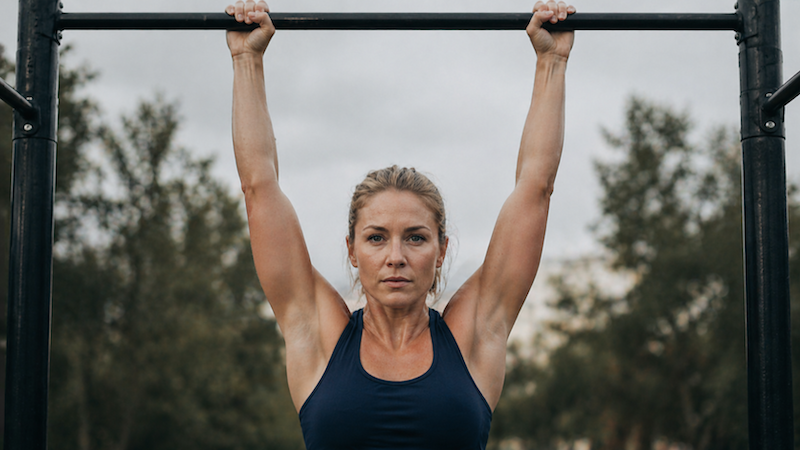
Pull-up guide: from zero to ten reps
You are at the park or the gym. You see the pull-up bar. You know you should use it, but you look at it the way you look at an exam you have not studied for. "I cannot do a single one." And you walk away.
You are not alone. Most adults cannot do a single pull-up the first time they try. And yet it is one of the most complete exercises that exists. That is why we include it in One Step Health: not because it is easy, but because it is worth it.
Why pull-ups matter
The pull-up is a compound exercise. That means it works several muscle groups at once:
- Latissimus dorsi (lats): the largest muscle in the back, the primary mover.
- Biceps brachii: the elbow flexor that assists the pulling motion.
- Middle and lower trapezius: scapular stabilizers.
- Rhomboids: scapular retractors that improve posture.
- Forearm muscles: grip strength, often the weakest link.
- Core: rectus abdominis and obliques work as stabilizers throughout the movement.
The review by Youdas et al. (Journal of Strength and Conditioning Research, 2010) confirmed that the pull-up significantly activates the latissimus dorsi, biceps, and lower trapezius, making it one of the most efficient upper-body pulling exercises.
Beyond that, the pull-up builds functional strength. Pulling yourself up, climbing, carrying, holding on: these are movement patterns we have used throughout our history as a species. The problem is that modern life has removed the need to do them, and with it the ability.
"I cannot do a single one": why that is normal
If you cannot do a pull-up, you do not have a problem. You have a starting point.
Data from Vaara et al. (BMC Public Health, 2012) on physical fitness in adult populations show that a significant percentage of adult men cannot perform a pull-up without prior training. For women, the percentage is even higher, and there is a direct physiological explanation.
The review by Miller et al. (European Journal of Applied Physiology, 1993) showed that women have, on average, 40-60% of men's upper body strength, while the gap in lower body strength narrows to 25-30%. This is not a defect: it is biology. And it does not mean women cannot do pull-ups. It means the path is somewhat longer, and they need more time in the assisted phases. Nothing more.
The important thing is this: any healthy person can learn to do pull-ups. Man or woman, 25 or 55 years old. It is a matter of progression.
The progression: from zero to your first pull-up
You do not jump from the ground to the bar. You build step by step. Each phase develops a specific component of the strength needed.
Phase 1: Dead hang
Simply hang from the bar with arms fully extended and hold. It sounds trivial, but it is not.
What it develops: grip strength, shoulder stability, connective tissue tolerance.
Goal: hold for 30 seconds without letting go. When you can do that consistently, move to the next phase.
Frequency: 3-4 times per week, 3-4 sets.
Phase 2: Scapular pulls
Hanging from the bar, without bending the elbows, pull your shoulder blades down and back. You will rise a few centimeters. Return to the starting position in a controlled manner.
What it develops: activation of the latissimus dorsi and lower trapezius. It is the "ignition" of the muscle that will pull you up.
Goal: 3 sets of 8-10 controlled reps.
Phase 3: Negatives (eccentric phase)
Get above the bar with help (a jump or a bench) until your chin is above it. From there, lower yourself as slowly as you can. Aim for a 5-second descent.
What it develops: eccentric strength, which is the foundation on which concentric strength (the pulling-up part) is built.
Research by Roig et al. (British Journal of Sports Medicine, 2009) showed that eccentric training produces greater strength and muscle mass gains than concentric training alone, especially in the initial phases.
Goal: 3 sets of 5 negatives with a 5-second descent.
Phase 4: Assisted pull-ups (with a resistance band)
Loop a resistance band over the bar and place one foot or knee in it. The band removes part of your bodyweight, making the movement accessible.
Progression within this phase: start with thick bands (more assistance) and gradually move to thinner ones. When you can do 3 sets of 8 with the thinnest band, you can very likely do your first unassisted pull-up.
Note for women: this phase tends to last longer. It can take weeks or months with bands before making the jump to a full pull-up. That is completely normal and is not an indicator that something is wrong. Strength is building; the upper-body strength-to-weight ratio simply needs more time to reach the threshold.
Phase 5: Your first pull-up
Pronated grip (palms facing away), slightly wider than shoulder-width. From a dead hang, pull your shoulder blades down, then flex your elbows until your chin clears the bar. Lower yourself in a controlled manner.
One rep. That is it. And it is enough to get started.
How long each phase takes
We are not going to give exact timelines because it depends on too many factors: bodyweight, prior activity level, training frequency, genetics. But as a general orientation:
| Phase | Men (approximate) | Women (approximate) |
|---|---|---|
| Dead hang to 30s | 1-2 weeks | 2-3 weeks |
| Scapular pulls 3x10 | 2-3 weeks | 3-4 weeks |
| Negatives 3x5 (5s) | 3-4 weeks | 4-8 weeks |
| Thin band 3x8 | 2-4 weeks | 4-12 weeks |
| First pull-up | 2-4 months total | 4-9 months total |
These ranges are intentionally wide. They are not targets or promises. They are what we see happen in practice.
From 5 to 10: the progression program
Once you can do 5 consecutive pull-ups, you need a systematic plan to keep advancing. The following program is based on the progression proposed by Fitness Revolucionario and works remarkably consistently.
The logic is simple: 5 sets per day in a descending pyramid structure. Each day you change one set, adding a rep to the lowest set. When all sets have moved up one level, you rest and start the next cycle.
| Day | Set 1 | Set 2 | Set 3 | Set 4 | Set 5 |
|---|---|---|---|---|---|
| 1 | 5 | 4 | 3 | 2 | 1 |
| 2 | 5 | 4 | 3 | 2 | 2 |
| 3 | 5 | 4 | 3 | 3 | 2 |
| 4 | 5 | 4 | 4 | 3 | 2 |
| 5 | 5 | 5 | 4 | 3 | 2 |
| 6 | Rest | ||||
| 7 | 6 | 5 | 4 | 3 | 2 |
| 8 | 6 | 5 | 4 | 3 | 3 |
| 9 | 6 | 5 | 4 | 4 | 3 |
| 10 | 6 | 5 | 5 | 4 | 3 |
| 11 | 6 | 6 | 5 | 4 | 3 |
| 12 | Rest | ||||
| 13 | 7 | 6 | 5 | 4 | 3 |
| 14 | 7 | 6 | 5 | 4 | 4 |
| 15 | 7 | 6 | 5 | 5 | 4 |
| 16 | 7 | 6 | 6 | 5 | 4 |
| 17 | 7 | 7 | 6 | 5 | 4 |
| 18 | Rest | ||||
| 19 | Rest | ||||
| 20 | Max test |
On day 20, do as many as you can. You will very likely hit 10.
If you do not get there, that is fine. Repeat the program starting from your current max. For example, if you got 8, your day 1 would be: 8, 7, 6, 5, 4. Same pyramid structure, but from your new ceiling.
Rest between sets: 2-3 minutes. Not less. Pull-ups are a relatively high-intensity effort and the nervous system needs to recover between sets.
Common mistakes
Kipping or swinging: using hip momentum to get up. It reduces the load on the muscles we want to develop and increases shoulder injury risk. Strict pull-ups, always.
Not going all the way down: if you do not fully extend your arms at the bottom, you reduce the range of motion and the stimulus. Full dead hang on every rep.
Skipping negatives: many people want to jump straight to the full pull-up. The eccentric phase is where the foundation is built. Do not skip it.
Training to failure every day: systematic muscular failure increases accumulated fatigue without improving results. The progression program works precisely because it keeps you away from failure most of the time.
In summary
| Concept | What matters |
|---|---|
| Muscles involved | Lats, biceps, trapezius, rhomboids, grip, core |
| Not being able to do one | This is normal; it is not a permanent limitation |
| Basic progression | Dead hang, scapular pulls, negatives, band, full pull-up |
| Men vs women difference | Women need more time in assisted phases; the goal is the same |
| From 5 to 10 | 20-day pyramid program with progressive increase |
| Most common mistake | Kipping, incomplete range, skipping negatives |
Pull-ups are not an exercise reserved for people who are already fit. They are an exercise that gets you fit. The road from zero to one is longer than from one to ten. But every phase builds something real: strength, control, confidence in what your body can do. And that is not something you lose easily.