
A practical guide to buying healthier non-perishable foods
You're standing in front of the canned goods shelf. There are fifteen different cans of tuna. Some in olive oil, some in sunflower oil, some in water. Some cost $1.50 and others $4.00. They all say things like "high in protein" or "rich in omega-3." You grab the cheapest one and keep walking. Or the one you always buy. Or the one with the nicest packaging.
Buying non-perishable foods is one of the most repetitive decisions in our diet. And also one of the most impactful, because what you keep in the pantry is what you eat on weeknights, when there's no time or energy to go shopping.
This guide isn't about buying expensive or hunting for specialty brands. It's about knowing what to look at so you can make slightly better decisions with the same products you already buy.
Why non-perishables matter more than you think
Non-perishable or long-shelf-life foods (canned goods, dried legumes, pasta, rice, nuts, spices) are the foundation of most people's actual diet. Not the organic fruit from Saturday's farmers market. The can of tuna on Tuesday night.
A study in the Journal of the Academy of Nutrition and Dietetics (Rickman et al., 2007) compared the nutritional content of fresh, frozen, and canned fruits and vegetables. The conclusion: nutritional differences are smaller than most people think. In many cases, canned and frozen products retain a similar percentage of vitamins and minerals as fresh, especially when the "fresh" produce has spent several days in transport and on the shelf.
This doesn't mean canned goods are better than fresh. It means they're a perfectly valid option, and sometimes more accessible in terms of price, availability, and convenience.
Legumes: dried vs. canned
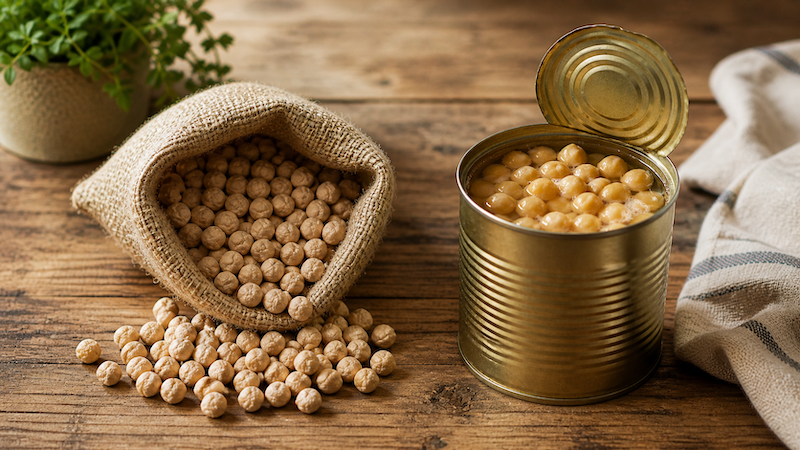
Legumes are probably the best non-perishable food that exists. Cheap, nutrient-dense, versatile, and with a shelf life measured in years.
Dried: cheaper per kilo ($2-4/kg), require soaking and cooking (30 minutes for lentils, 1-2 hours for chickpeas). A kilo of dried lentils yields about 2.5 times its weight once cooked, meaning roughly 2.5 kg of ready-to-eat lentils.
Canned: more expensive per serving (but we're talking $0.80-1.50 per 400g can), ready in 2 minutes. Nutritionally very similar to home-cooked dried legumes. The main drawback: they usually contain added salt. The solution is rinsing them under running water, which reduces sodium by about 40% according to a study in Journal of Culinary Science & Technology (Jones & Dahl, 2009).
For most people, having both is ideal. Dried for when there's time to cook. Canned for quick days.
| Dried | Canned | |
|---|---|---|
| Price per serving | $0.20-0.40 | $0.60-0.90 |
| Prep time | 30 min - 2 hours | 2 minutes |
| Sodium | Low (you control it) | High (reduce by rinsing) |
| Nutritional value | Reference | Similar (after rinsing) |
Canned fish: what to look for
Not all cans of fish are the same. What varies is the type of oil, the salt, and the fish itself.
Type of oil. Olive oil > extra virgin olive oil > sunflower oil > brine. Olive oil provides monounsaturated fats with proven cardiovascular benefit. Sunflower oil provides mainly omega-6 fatty acids, which in excess can be pro-inflammatory. It's not toxic, but if you can choose, choose olive.
In water (packed in its own juices). If what you're after is protein with minimal added fat, this is the option. Tuna in water has about 100 kcal and 24g of protein per 100g. In olive oil, it rises to about 190 kcal because of the absorbed oil.
Sardines vs. tuna. Sardines provide more long-chain omega-3s (EPA/DHA) than tuna because they're small oily fish. Additionally, being lower on the food chain, they accumulate less mercury. A report from the EFSA (European Food Safety Authority, 2012) recommends limiting tuna to 3-4 servings per week for adults for this reason. The FDA similarly advises moderation with albacore tuna. Sardines don't have that practical limitation.
Sodium. Compare sodium per 100g between brands. It can range from 300mg to 800mg. Less is better, especially if you add salt when cooking.
Pasta and rice: whole grain vs. refined
The difference between the whole grain and refined versions isn't as vast as the marketing suggests, but it's real.
Whole wheat pasta vs. regular pasta (per 100g dry):
| Regular | Whole wheat | |
|---|---|---|
| Calories | 350 kcal | 340 kcal |
| Protein | 12g | 13g |
| Fiber | 2g | 7g |
| Glycemic index | ~55 | ~40 |
The big difference is fiber. 7g vs. 2g per 100g. That translates to more satiety and a more gradual effect on blood sugar.
Brown rice vs. white rice (per 100g dry):
| White | Brown | |
|---|---|---|
| Calories | 360 kcal | 350 kcal |
| Protein | 7g | 7.5g |
| Fiber | 0.4g | 3.5g |
Here the difference is less dramatic but still meaningful for fiber. Brown rice takes longer to cook (35-40 minutes vs. 12-15 minutes) and has a different texture that not everyone likes.
You don't need a total conversion. If you currently eat only refined, starting with a 50/50 mix is already a significant change.
Packaged nuts and seeds
Nuts are an interesting case in the non-perishable aisle. They're calorically dense (550-650 kcal per 100g), but also nutritionally dense: unsaturated fats, protein, fiber, magnesium, zinc.
What to look for: No salt. Not fried. No sugar, honey, or chocolate coating. The "natural" or "raw" version is almost always the best option. A bag of raw almonds has one ingredient: almonds. A bag of roasted and salted almonds has three or four.
Peanut butter. Reading the label is essential here. Quality peanut butter has one ingredient: peanuts (or peanuts and salt). Many commercial brands add palm oil, sugar, and emulsifiers. Per 100g, the difference in sugar can be 1g vs. 10g.
Reasonable portion: a handful (30g). That's about 170-180 kcal. Not a snack to eat directly from the bag. Serving the portion and putting the bag away prevents accidentally eating 100g (550+ kcal).
Tomatoes and canned vegetables
Crushed or canned tomatoes. One of the most useful pantry products. Look for: no added sugar (many brands add it), no more ingredients than tomatoes and salt. A good crushed tomato has two ingredients: tomatoes and salt. If it has more than five, it probably includes sugar, modified starch, or flavor enhancers.
Cooked tomatoes preserve lycopene well, an antioxidant whose bioavailability increases with cooking (Gartner et al., American Journal of Clinical Nutrition, 1997).
Canned vegetables. Artichoke hearts, green beans, roasted peppers. These are valid options when fresh vegetables aren't available. Like legumes, rinsing them reduces sodium. Look for the ones with the fewest ingredients: vegetable, water, and salt.
How to compare two products of the same type
We've covered the per-100g trick in how to read nutrition labels. Here we apply it to the non-perishable aisle with a simple rule:
- Same type of product: always compare within the same category (tuna with tuna, not tuna with sardines).
- Per 100g: ignore the suggested serving.
- Prioritize: less sugar, less sodium, more fiber, more protein. In that order of importance for most products in this section.
- Short ingredients list: fewer ingredients is generally better. If one product has 3 ingredients and another has 12, the one with 3 is almost always the better choice.
- Store brand vs. name brand: for basic canned goods (legumes, tomatoes, tuna), store brands usually have exactly the same ingredients and nutritional values as name brands. The difference is the packaging and the price.
Budget: eating well with non-perishables isn't expensive
A weekly non-perishable shop for one person, covering the pantry base:
| Product | Quantity | Approx. price |
|---|---|---|
| Dried lentils | 500g | $1.50 |
| Canned chickpeas | 2 cans (800g) | $2.50 |
| Brown rice | 1 kg | $2.50 |
| Whole wheat pasta | 500g | $1.80 |
| Sardines in olive oil | 2 cans | $3.00 |
| Tuna in water | 2 cans | $2.50 |
| Crushed tomatoes | 2 cans (800g) | $2.00 |
| Raw almonds | 200g | $3.50 |
| Extra virgin olive oil | 500ml | $6.00 |
| Total | ~$25 |
$25 covers the base of protein, carbs, fat, and fiber for a week. What's missing is fresh food (fruit, vegetables, eggs, dairy), but the skeleton is there.
What's not worth the premium
"Enriched" products. Pasta with added omega-3, rice with vitamins. If you eat legumes, fish, and vegetables, you don't need your pasta to have artificially added omega-3. And they cost twice as much.
"Protein" versions of everything. Protein pasta, protein bread, protein snacks. They usually add pea or whey protein to a product that doesn't need it, at a price two or three times higher. If you need more protein, a can of chickpeas has it naturally.
Buying in bulk without a plan. A 24-pack of tuna cans seems efficient. But if you don't have a minimal meal plan, those cans sit in the pantry for months and you end up ordering pizza.
In summary
| Category | What to choose |
|---|---|
| Legumes | Dried for cooking, canned for quick days. Rinse the canned ones |
| Canned fish | Prefer sardines for omega-3 and less mercury. Olive oil > sunflower oil |
| Pasta and rice | Start with 50/50 whole grain-refined if you don't eat whole grain now |
| Nuts | No salt, not fried, no coating. 30g as a portion |
| Tomatoes | Crushed with 2-3 ingredients (tomatoes, salt). No added sugar |
| Comparing products | Per 100g. Short ingredients list. Store brands work fine |
| Budget | A weekly non-perishable base runs about $20-25 |
Better shopping doesn't require a degree in nutrition. It requires a few criteria applied consistently. And the best thing about non-perishables is that you make the decision once and it lasts for weeks. That makes them the most efficient place to improve your diet without changing your daily routine.