
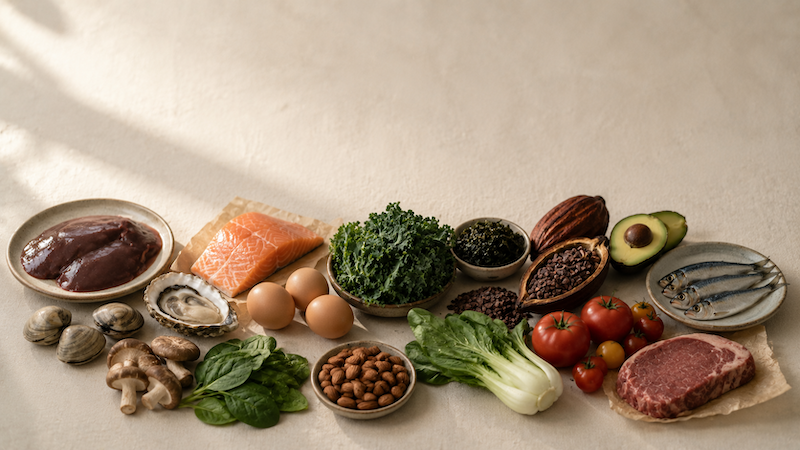
The 15 most nutrient-dense foods on the planet
Not all foods are equal. Two plates with the same calories can have radically different nutritional profiles. Nutrient density measures exactly that: how much real nutritional value a food delivers per calorie consumed.
This list isn't a hierarchy of magic "superfoods" or a promise of rapid transformation. It's a practical map for understanding which foods give your body the most for the amount you eat — and how to incorporate them in a sustainable way.
What "nutrient-dense" actually means
A nutrient-dense food provides a high amount of vitamins, minerals, protein, or essential fatty acids relative to its calorie content. The opposite concept is "empty calories": foods with plenty of energy but little real nutritional value (refined sugar, ultra-processed products).
Nutrient density matters because the body needs micronutrients — not just macros. A person can eat enough calories and still be deficient in iron, vitamin D, magnesium, or zinc without realizing it. That silent deficit affects performance, recovery, sleep, and mood.
The 15
1. Grass-fed liver
Probably the most nutrient-dense food that exists. A 100 g portion of beef liver delivers 700% of the daily value for vitamin B12, 200% of vitamin A, highly bioavailable iron, and copper. You don't need to eat it every day — once a week is enough to notice the impact.
Upper limit note: Vitamin A in liver accumulates in the body. More than 100–150 g once or twice a week is not recommended for pregnant women or anyone on retinol supplements.
2. Shellfish
Clams, mussels, oysters, and cockles are extraordinary sources of iron, zinc, vitamin B12, and iodine. Oysters in particular are one of the best dietary sources of zinc that exist — a mineral most people consume below recommended levels and which plays a critical role in immune function and muscle recovery.
3. Salmon
Omega-3 fat, complete protein, vitamin D, selenium, and B12 in a single food. Wild salmon has an especially good lipid profile. Two seafood servings a week — one of them oily fish — is the recommendation from the American Heart Association's Scientific Advisory (Rimm et al., 2018, Circulation), enough to cover the omega-3 needs of most adults. If you like sushi, salmon sashimi is one of the best ways to eat it.
4. Eggs
One of the most complete foods that exists. The yolk — demonized for decades over cholesterol — is where most of the nutritional value lives: vitamins A, D, E, and K, choline (essential for cognitive function), and lutein. Current evidence doesn't support restricting eggs in healthy people: an analysis of three large US prospective cohorts with more than 215,000 participants, published in BMJ (Drouin-Chartier et al., 2020), found no association between moderate egg consumption (up to one a day) and cardiovascular risk in the general population.
5. Kale
The most recognizable representative of the cruciferous family. 100 g delivers more vitamin C than an orange, significant amounts of vitamin K1 (crucial for coagulation and bone health), calcium, and glucosinolate compounds with documented anti-inflammatory properties. Unlike many vegetables, it holds up well to cooking without losing too many micronutrients.
6. Seaweed
Seaweed is practically the only significant dietary source of iodine outside of fish and iodized salt. Iodine is essential for thyroid function, and mild deficiency is still prevalent even in developed countries — a global analysis published in the Journal of Nutrition (Andersson et al., 2012) estimated that nearly a third of the world's school-age population had inadequate intake. Nori (the seaweed that wraps maki rolls) provides iodine, vitamin B12, and trace minerals like iron and magnesium.
Upper limit note: Seaweed, especially kombu and hijiki, can contain very high levels of iodine. Nori is moderate and safe for daily consumption; other varieties are best eaten occasionally.
7. Pure cocoa
Not sugary milk chocolate. Unsweetened cocoa powder or dark chocolate with more than 85% cocoa is a meaningful source of magnesium, iron, manganese, and flavanols with documented positive effects on blood pressure and endothelial function. A systematic review and meta-analysis in American Journal of Clinical Nutrition (Hooper et al., 2012) analyzed the evidence on cocoa flavanols and found consistent improvements in blood pressure, insulin sensitivity, and endothelial function.
8. Avocado
Unlike most fruits, avocado provides monounsaturated fat (oleic, the same as olive oil), potassium (more than a banana per equivalent portion), vitamin K, and folate. Its fat improves the absorption of fat-soluble vitamins present in other foods on the same plate — a good argument for pairing avocado with leafy green salads.
9. Sardines
Small, cheap, and extraordinarily nutrient-dense. Canned sardines (with bones) are one of the best calcium sources available, plus omega-3, vitamin D, B12, and selenium. Eating the soft bones makes the bioavailable calcium comparable to dairy. A tin of sardines has about 350 mg of calcium — more than 30% of the daily value.
10. Shiitake mushrooms
Mushrooms are the only plant food that produces vitamin D in any meaningful amount when exposed to sun or UV light (as happens with some commercial varieties). Shiitake also provide copper, selenium, and polysaccharides like lentinan, studied for their immunomodulating effects — though most of that evidence comes from injectable pharmaceutical use as an adjuvant in oncology in Japan, not from regular dietary consumption. As a food, the real value is in the micronutrients.
11. Spinach
Iron, folate, vitamin K, magnesium, and antioxidants like lutein and zeaxanthin, associated with slower progression of macular degeneration in the AREDS2 trial (JAMA, 2013). The iron in spinach is non-heme (lower bioavailability than animal iron), but it absorbs significantly better when paired with vitamin C (Hallberg and Hulthén, 2000, American Journal of Clinical Nutrition) — squeezing lemon on it isn't just a flavor thing.
12. Almonds
Of all nuts, almonds have one of the most complete profiles: vitamin E (25% of the daily value in a 30 g handful), magnesium, calcium, fiber, and unsaturated fat. As we explained in small diet changes that last, swapping processed snacks for a handful of almonds is one of the changes with the best effect-to-friction ratio.
13. Bok choy
One of the lesser-known but most complete vegetables. It provides vitamin C, vitamin K, vitamin A, calcium, and glucosinolates like the rest of the cruciferous family. Its practical advantage: mild flavor, fast cooking (sautéed in 3 minutes), and a very low calorie density that lets you eat generous amounts without significant caloric impact.
14. Grass-fed beef
Grass-fed beef has a different lipid profile from confinement-raised animals: higher proportion of omega-3, higher concentration of conjugated linoleic acid (CLA), and more vitamin E and beta-carotene, according to a review published in Nutrition Journal (Daley et al., 2010). As a source of protein and micronutrients like heme iron and zinc, red meat has a legitimate role in a balanced diet — consumed in moderation and in the right form.
15. Tomatoes
Last on the list, but not the least relevant. Tomatoes are one of the most important dietary sources of lycopene — an antioxidant carotenoid whose bioavailability increases significantly with heat processing and in the presence of fat (Gärtner et al., 1997, American Journal of Clinical Nutrition): tomato sauce cooked with oil delivers several times more absorbable lycopene than raw tomato. They also provide vitamin C, potassium, and folate.
Combinations that work harder
A few of the foods above are notably more effective when eaten together. These aren't rules — they're useful patterns.
- Iron + vitamin C: Non-heme iron (spinach, kale, legumes) absorbs significantly better alongside vitamin C. Add lemon to spinach, tomato to lentils, or kale to a citrus-dressed salad.
- Fat-soluble vitamins + fat: Vitamins A, D, E, and K need dietary fat to be absorbed. Eating liver, kale, or bok choy alongside avocado, olive oil, or sardines isn't just a flavor pairing — it makes the micronutrients more bioavailable.
- Cooked tomato + oil: Lycopene from tomatoes is far more absorbable after cooking and in the presence of fat. Tomato sauce with a drizzle of olive oil is one of the most efficient delivery systems on this list.
- Lemon on anything green: Adds vitamin C (improving iron and mineral absorption) and makes leafy greens more palatable — a double win.
If you don't eat animal products
The list above is heavily animal-based. That's not a bias — it's where the highest-density micronutrients tend to concentrate. But several alternatives cover most of the same ground:
- Liver, shellfish, meat → iron and B12: The non-heme iron in legumes (lentils, black beans) absorbs better with vitamin C. B12 is the one nutrient that genuinely requires supplementation or fortified foods on a fully plant-based diet — there's no reliable plant source.
- Salmon, sardines → omega-3: Algae-based omega-3 supplements provide EPA and DHA directly (the same forms found in fish, which themselves get it from algae). Flaxseed and walnuts provide ALA, which the body converts at a low rate.
- Eggs → choline: Soybeans, quinoa, and Brussels sprouts contain some choline, though at lower concentrations than egg yolk.
- Fermented foods — not on this list, but worth adding: kimchi, tempeh, miso, and kefir provide live cultures, B vitamins, and in the case of tempeh, a more bioavailable form of plant protein. If your diet skips fermented dairy, tempeh and kimchi are practical substitutes.
How to use this list sensibly
None of these 15 foods is mandatory. Nutrient density is a tool for prioritizing — not a homework list.
The most practical way to apply it: identify two or three foods on this list you eat little or none of, and add one each month. No need for drastic changes. A handful of almonds replacing some cookies, sardines once a week instead of deli meat, kale or spinach in your usual stir-fry.
The pattern matters more than individual foods. But if the pattern is built mostly around foods like these — varied, real, minimally processed — most of the nutritional work is already done.
In summary
| Food | What it brings to the table | Practical note |
|---|---|---|
| Grass-fed liver | B12, vitamin A, heme iron, copper | 1x/week is enough; limit in pregnancy |
| Shellfish (oysters, clams, mussels) | Zinc, iron, B12, iodine | — |
| Salmon | Omega-3, vitamin D, complete protein | Wild preferred; 2x/week |
| Eggs | Choline, vitamins A, D, E, K, lutein | Up to 1/day, no cardiovascular risk in healthy people |
| Kale | Vitamin C, K1, calcium, glucosinolates | Holds up well to cooking |
| Seaweed (nori) | Iodine, B12, trace minerals | Stick to nori for regular use |
| Pure cocoa (>85%) | Magnesium, iron, flavanols | — |
| Avocado | Monounsaturated fat, potassium, folate | Boosts absorption of fat-soluble vitamins |
| Sardines (with bones) | Calcium, omega-3, vitamin D, B12 | Cheap, canned works perfectly |
| Shiitake mushrooms | Vitamin D, lentinan, copper, selenium | Choose UV-exposed varieties |
| Spinach | Non-heme iron, folate, lutein, magnesium | Add lemon to improve iron absorption |
| Almonds | Vitamin E, magnesium, fiber | 30 g handful |
| Bok choy | Vitamins A, C, K, calcium | Sautéed in 3 minutes |
| Grass-fed beef | Heme iron, zinc, CLA, omega-3 | In moderation |
| Tomatoes (cooked) | Lycopene, vitamin C, potassium | Cook with oil for maximum lycopene |
These 15 foods aren't a closed list or a goal. They're reference points. If your week includes several of them — without obsessing over which ones or how many — the background nutritional work is covered. The rest is enjoying what you eat.
References
- Andersson M, Karumbunathan V, Zimmermann MB. Global iodine status in 2011 and trends over the past decade. J Nutr. 2012;142(4):744-50. doi:10.3945/jn.111.149393
- The Age-Related Eye Disease Study 2 (AREDS2) Research Group. Lutein + zeaxanthin and omega-3 fatty acids for age-related macular degeneration. JAMA. 2013;309(19):2005-15. doi:10.1001/jama.2013.4997
- Daley CA, Abbott A, Doyle PS, Nader GA, Larson S. A review of fatty acid profiles and antioxidant content in grass-fed and grain-fed beef. Nutr J. 2010;9:10. doi:10.1186/1475-2891-9-10
- Drouin-Chartier JP, Chen S, Li Y, et al. Egg consumption and risk of cardiovascular disease: three large prospective US cohort studies, systematic review, and updated meta-analysis. BMJ. 2020;368:m513. doi:10.1136/bmj.m513
- Gärtner C, Stahl W, Sies H. Lycopene is more bioavailable from tomato paste than from fresh tomatoes. Am J Clin Nutr. 1997;66(1):116-22. doi:10.1093/ajcn/66.1.116
- Hallberg L, Hulthén L. Prediction of dietary iron absorption: an algorithm for calculating absorption and bioavailability of dietary iron. Am J Clin Nutr. 2000;71(5):1147-60. doi:10.1093/ajcn/71.5.1147
- Hooper L, Kay C, Abdelhamid A, et al. Effects of chocolate, cocoa, and flavan-3-ols on cardiovascular health: a systematic review and meta-analysis of randomized trials. Am J Clin Nutr. 2012;95(3):740-51. doi:10.3945/ajcn.111.023457
- Rimm EB, Appel LJ, Chiuve SE, et al. Seafood long-chain n-3 polyunsaturated fatty acids and cardiovascular disease: a science advisory from the American Heart Association. Circulation. 2018;138(1):e35-e47. doi:10.1161/CIR.0000000000000574