
How to actually read a nutrition label (without overthinking it)
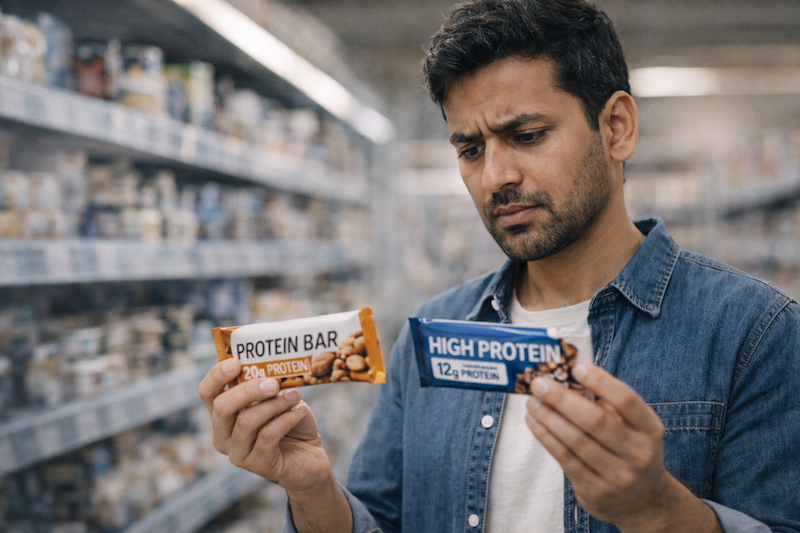
You're in the grocery store, holding two protein bars. One says "30g protein" and the other says "no added sugar." Both have a nutrition panel that looks like a bank statement. You put them both back and grab the one you always buy. We've all been there.
Reading labels isn't hard. The problem is that nobody has explained what to look at and in what order. Let's fix that.
First things first: serving size
Before looking at calories, fat, or protein, there's one thing to check: the serving size on the label. It's the most ignored number and the one that distorts everything else.
A package of cookies might say "89 kcal per serving," and the serving is 2 cookies. If you eat 6 (a pretty normal amount), that's 267 kcal. The label isn't lying. It's just that the manufacturer's idea of a "serving" rarely matches what people actually eat.
The FDA requires nutrition information per serving, but serving sizes are based on Reference Amounts Customarily Consumed (RACCs), which were updated in 2016 to better reflect actual eating habits. In the EU, Regulation 1169/2011 mandates per-100g information, which makes comparing products much easier.
Practical rule: whenever available, look at the "per 100g" column. It's the only way to compare two products fairly. In the US, where labels show per-serving only, compare the serving sizes first, then do the mental math.
The four numbers that matter
A nutrition label has a lot of numbers. You don't need to memorize all of them. Focus on these four, per 100g (or per serving if that's all you have):
Calories (kcal). Total energy. A context number. Plain yogurt is around 60 kcal/100g. Cookies are around 450 kcal/100g. Cookies aren't "bad," but 100g of cookies gives you the same energy as 750g of yogurt. Worth knowing.
Protein (g). How much of the product contributes to building and maintaining muscle tissue. General range: protein-rich foods have over 15g/100g. Cereals usually land between 7 and 12g.
Sugars (g). Within carbohydrates, the sugars line shows total sugars: both naturally occurring (lactose in yogurt, fructose in fruit) and added. The WHO recommends limiting free sugars to less than 25g per day (WHO, 2015). A 330ml can of soda can have 35g.
Saturated fat (g). Not all fats are equal. Saturated fats are the ones most consistently linked to cardiovascular risk when consumed in excess (Sacks et al., Circulation, 2017). Under 5g/100g is a good benchmark for most products.
The per-100g trick for comparing
Imagine two tomato sauces. One says "only 30 kcal per serving" (serving: 30g). The other says "45 kcal per serving" (serving: 50g). At first glance, the first one looks better. But look at the per-100g numbers:
| Sauce A (per 100g) | Sauce B (per 100g) | |
|---|---|---|
| Calories | 100 kcal | 90 kcal |
| Sugars | 12g | 6g |
| Saturated fat | 1.5g | 0.8g |
| Sodium | 840mg | 520mg |
Sauce B wins across the board. But Sauce A appeared to be the winner "per serving" because its serving was smaller. Many manufacturers do this. It's not illegal. But it is misleading.
How to spot hidden sugars
The ingredients list is mandatory and ordered by weight, from most to least. If sugar is in the first three positions, the product has a lot of sugar. But manufacturers know this, so they sometimes split sugar into multiple forms so each one appears lower on the list.
Names that mean added sugar:
- Anything ending in -ose: glucose, fructose, sucrose, dextrose, maltose
- Syrups: corn syrup, high-fructose corn syrup, rice syrup, agave syrup, maple syrup
- Honey, molasses, fruit juice concentrate
- Maltodextrin, dextrin
A study published in JAMA Internal Medicine (Yang et al., 2014) found that people who consumed 17-21% of their calories from added sugar had a 38% higher risk of dying from cardiovascular disease compared to those who consumed less than 8%.
What the front-of-package claims actually mean
The words splashed across the front of the package (light, zero, whole grain, natural) aren't just marketing. They're regulated. But they don't always mean what we think.
Light / lite. Under FDA regulations, "light" means 50% less fat or one-third fewer calories than the reference product. In the EU (Regulation EC 1924/2006), it means at least 30% less of the highlighted nutrient. But "30% less" of a lot is still a lot. Light potato chips with 30% less fat still have more fat than most foods.
Zero / sugar-free. Means less than 0.5g of sugar per serving (FDA) or per 100g (EU). It doesn't mean it's healthy. A "zero" soda has 0 calories but is still water with sweeteners and additives.
Whole grain. In the US, the FDA has no strict definition for "whole grain" on packaging. A product can contain mostly refined flour with a small amount of whole grain and still say "made with whole grains." The Whole Grains Council's stamp requires at least 8g of whole grains per serving for the basic stamp. The real check: look at the ingredients list. Whole grain flour should be the first ingredient.
No trans fat. The FDA allows "0g trans fat" if the product has less than 0.5g per serving. Check the ingredients: if you see "partially hydrogenated oil," there are trans fats, just in small amounts per serving.
Practical exercise: reading a protein bar
Let's take a typical "high protein" bar from any grocery store. The kind with bold lettering and a picture of someone mid-workout. Typical values per 100g:
| Nutrient | Typical value |
|---|---|
| Calories | 370-400 kcal |
| Protein | 25-30g |
| Carbohydrates | 35-45g |
| of which sugars | 15-25g |
| Fat | 12-18g |
| of which saturated | 6-10g |
| Fiber | 3-5g |
A bar weighs 45-60g, so one bar is roughly 200-220 kcal. That sounds reasonable. But look at the sugar line: 15-25g per 100g means a single bar can pack 9-15g of sugar. That rivals a candy bar of the same size.
And there's a detail the label doesn't make obvious. Many protein bars use sugar alcohols (maltitol, erythritol, sorbitol) to keep the "sugars" number down. These don't appear in the sugars line, but they still have caloric impact (maltitol is roughly 2-3 kcal/g) and can cause bloating, gas, and other digestive side effects in moderate amounts. If the ingredients list includes sugar alcohols, the real caloric content is higher than the label suggests.
Now compare with a simple alternative: 2 boiled eggs and 30g of almonds.
| Nutrient | 2 eggs + 30g almonds |
|---|---|
| Calories | ~300 kcal |
| Protein | 20g |
| Carbohydrates | 3g |
| of which sugars | 1g |
| Fat | 23g (mostly unsaturated) |
| of which saturated | 5g |
| Fiber | 3g |
Slightly more calories, comparable protein, and almost no sugar. The fat is higher, but it's predominantly unsaturated fat from the almonds. No sugar alcohols, no processing, no mystery ingredients.
Protein bars are convenient. That's their real value. But convenient and healthy are not the same thing. If you do buy bars, look for ones with less than 5g of sugar per bar, more than 20g of protein, and an ingredients list you can actually read. The shorter that list, the better.
What's not worth obsessing over
Reading labels is useful, but it has limits. You don't need to analyze every product every time you shop. A few conscious reading sessions when you try a new product is enough. Once you know what you regularly buy, you don't need to re-read the label every week.
It's also not worth comparing decimals. The difference between 2.1g and 2.3g of saturated fat is irrelevant. What matters is the overall pattern: catching products that have significantly more sugar, sodium, or fat than they appear to.
And one more thing: labels don't measure the total quality of a food. An avocado has a lot of fat. A banana has a lot of sugar. Both are excellent foods. Fresh products without labels (fruits, vegetables, bulk legumes, fish, fresh meat) are usually the best options precisely because they don't need to convince you of anything.
In summary
| Principle | In practice |
|---|---|
| Always look at per 100g | Ignore the "per serving" column for fairer comparisons |
| The 4 key numbers | Calories, protein, sugars, saturated fat |
| Spot hidden sugars | Look for ingredients ending in -ose, syrups, honey, maltodextrin |
| "Light" doesn't mean "healthy" | It just means 30-50% less than the original |
| "Whole grain" isn't guaranteed | Check that whole grain flour is the first ingredient |
| Don't obsess | A few conscious reads are worth more than analyzing every purchase |
Reading a label doesn't make you a nutritionist, and it shouldn't become an obligation. But spending 30 seconds looking at the right numbers, in the right order, gives you a tool that works for life. And that's enough.